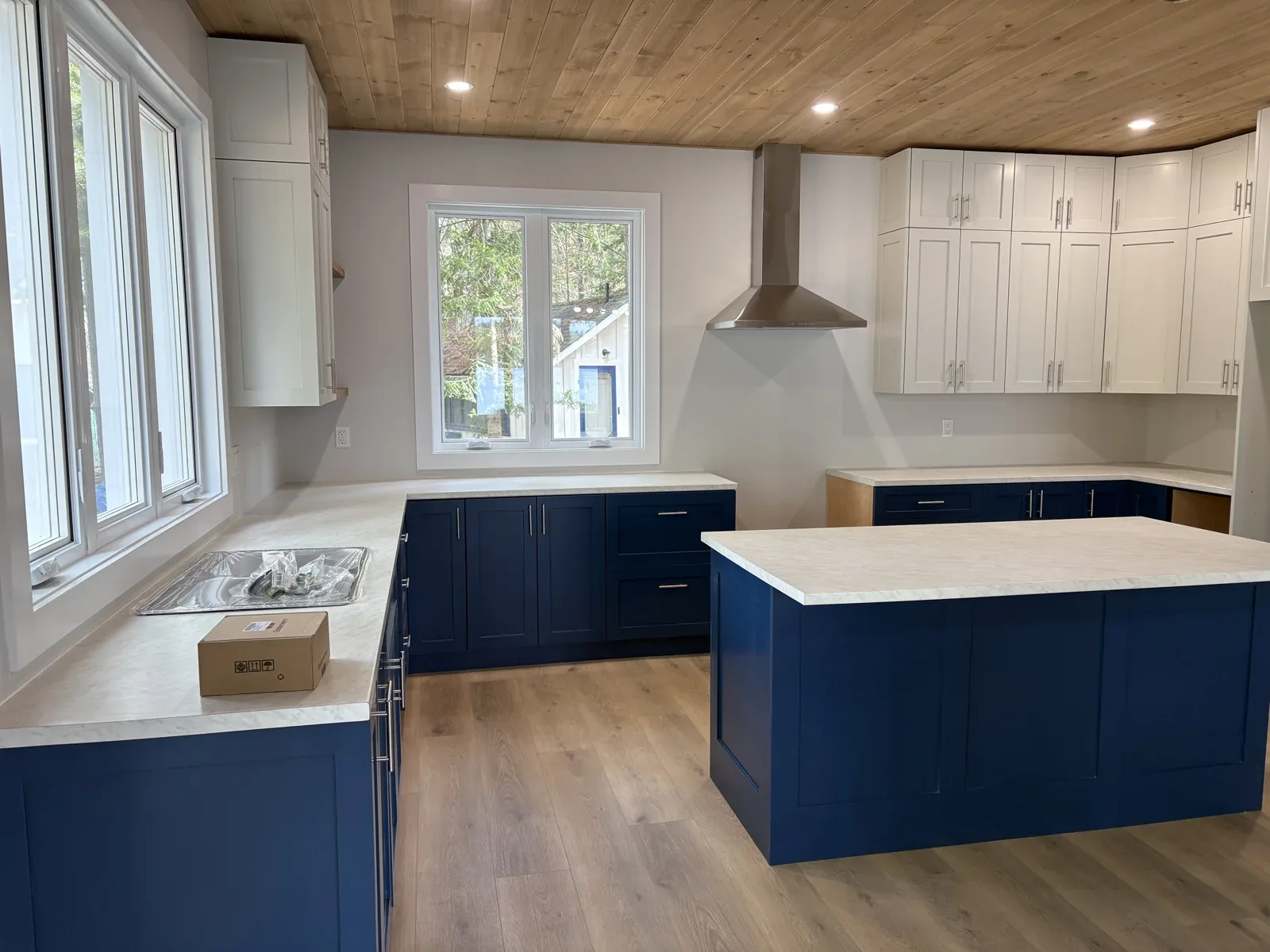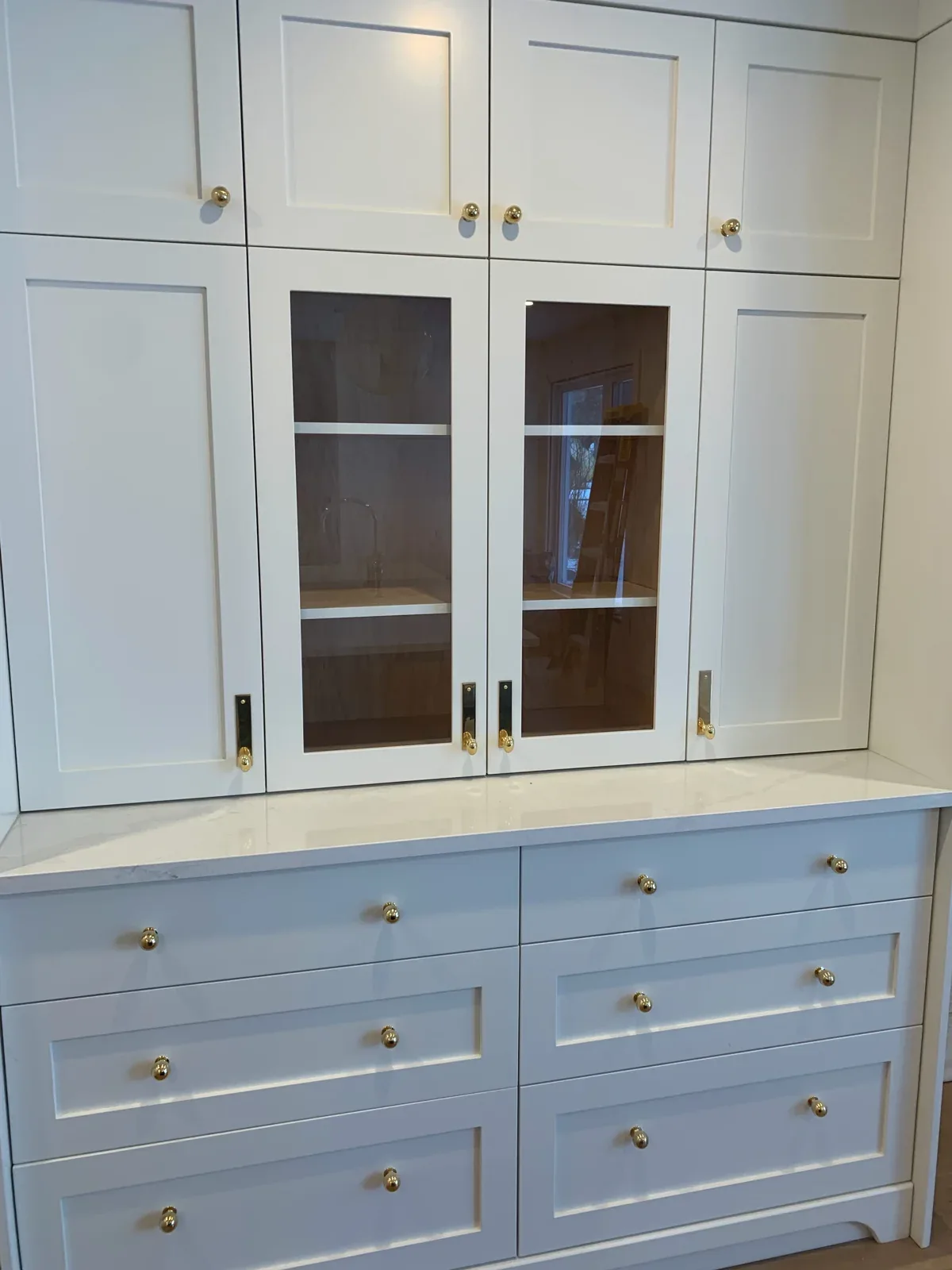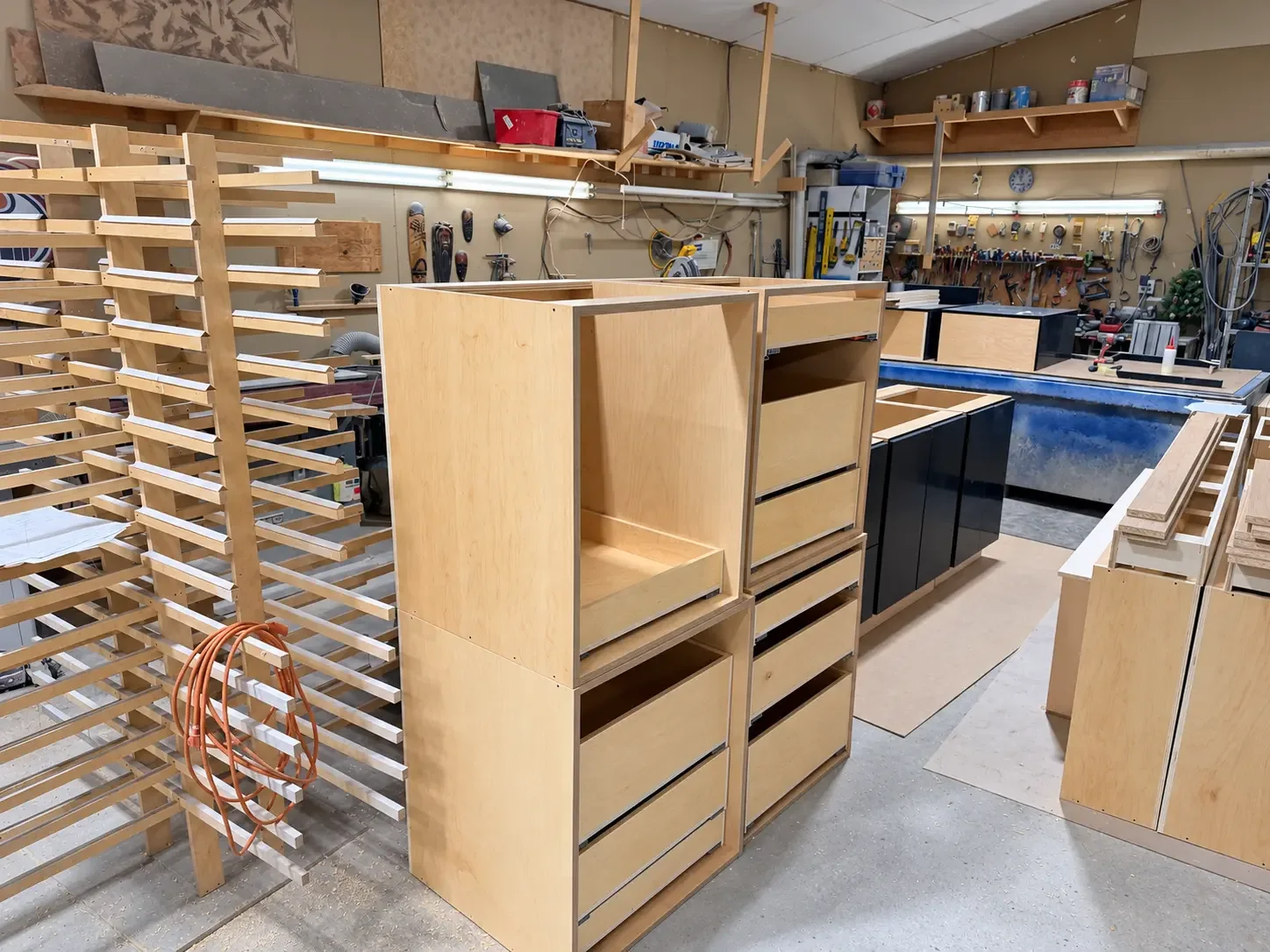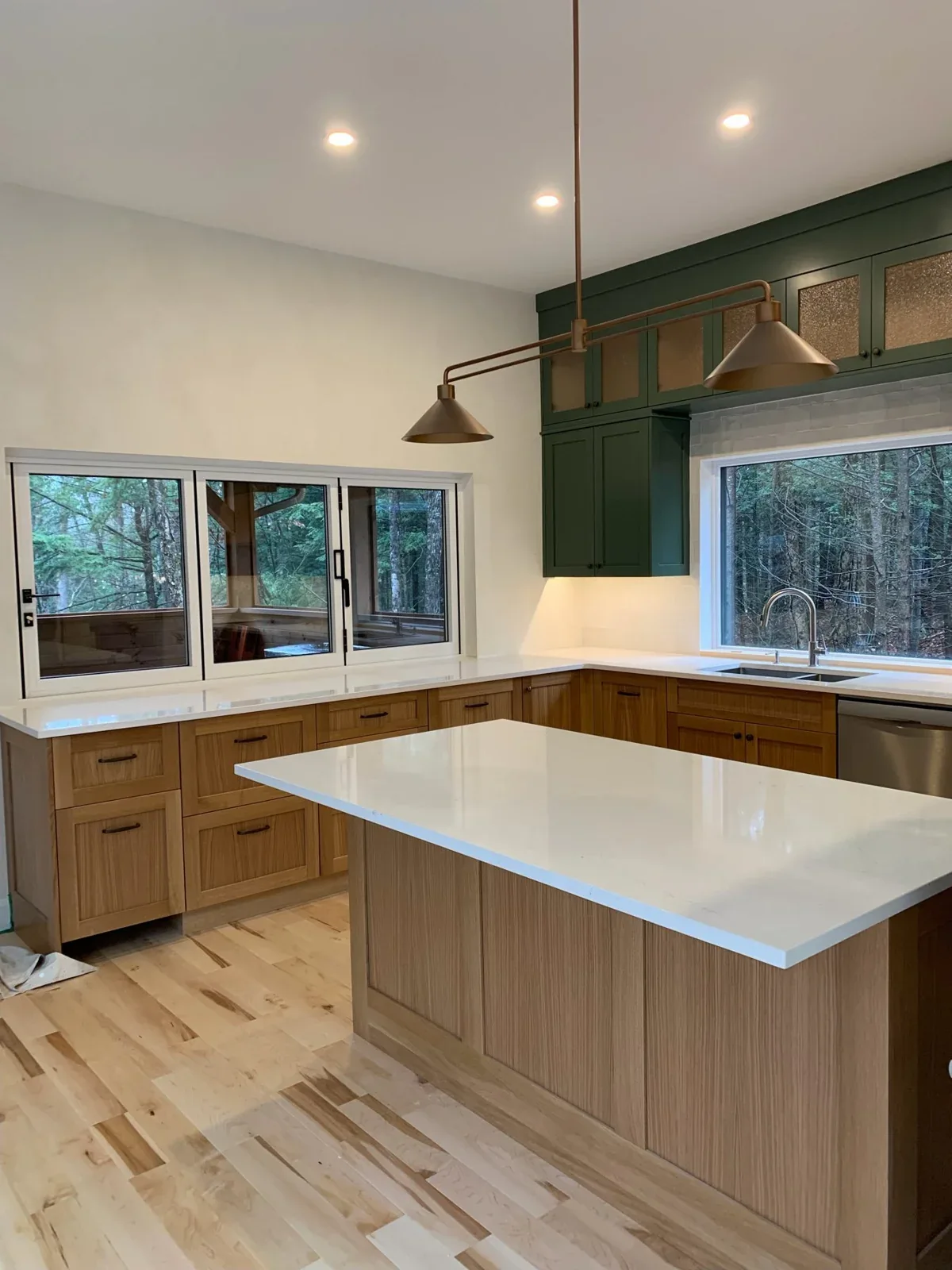
Choosing wood for cabinetry becomes much easier when you separate three decisions: the species, the way its grain is presented, and the finish applied over it. A photograph labelled “oak kitchen” does not tell you enough to reproduce the look. Two samples of the same species can lead a room in very different directions.
For an Ottawa or Gatineau home, start with the room you actually have. Consider its daylight, existing floors, nearby furniture, and the amount of cabinetry in view. Then use physical samples to narrow the choices. The aim is not to find a universally superior wood. It is to choose an appearance and construction approach you understand, including the natural variation that will arrive with the finished work.
Describe the look before naming a species
Begin with plain descriptions. Do you want quiet, mostly straight lines or a more expressive pattern? Should the cabinetry feel pale and restrained, warmly coloured, or noticeably dark? Would you enjoy variation between doors, or would that distract you every morning?
These questions are more useful than beginning with a fashionable species name. A person who says “white oak” may really be asking for a pale colour, a straight grain, or a particular sheen. Those are related decisions, but they are not interchangeable. Share what appeals to you in a reference image and what you would prefer to avoid.
Collect a small group of images rather than an endless folder. For each one, identify the specific feature you like: the grain direction on an island, the relationship to the floor, or the gentle contrast between panels. If two images conflict, notice that early. A clear visual brief helps the cabinetmaker propose samples that answer your priorities instead of guessing from a label.
Understand where solid wood and veneer belong
Veneer is a thin layer of real wood used as a decorative face over a substrate. It is different from a printed wood-look surface. Solid wood and veneer can appear in the same cabinet project, often in different components, so “wood cabinetry” does not describe the whole construction.
Ask which parts will be solid wood, which will be veneered panels, and what substrate and edge details are proposed. A large flat door, a frame component, and an exposed end panel do not necessarily need identical constructions to look coordinated.
Avoid treating veneer as an automatic downgrade or solid wood as an automatic guarantee. The useful questions concern the complete assembly, its intended application, its edges, and how it will be finished. Wood also responds to changes in moisture conditions; construction needs to account for the material rather than expect it to behave like a fixed printed pattern.
For a mixed assembly, ask to see the solid and veneered components together. The same species name does not guarantee identical colour or figure across different pieces. A sample door with the intended materials can reveal relationships that a loose piece of lumber cannot.
Evaluate oak through its grain, not its reputation
Oak is often chosen for an evident grain pattern, but an oak specification still needs refinement. Ask which oak is proposed and review the actual samples. Do not assume that the words “red” and “white” describe a finished cabinet colour precisely; the selected wood and finishing approach both matter.
Next, look at the grain character. A sample with sweeping patterns creates a different rhythm from one with straighter lines. That difference becomes much more noticeable across a wall of doors than on a small chip. If you want a calm result, say what that means visually instead of relying only on the word “modern.”
Picture the oak next to the room’s existing wood. Matching an oak floor exactly may be harder, and less necessary, than choosing a deliberate relationship. Try a lighter cabinet, a different grain direction, or a clearly distinct tone in samples before deciding that everything must blend.
Also consider where the strongest pattern belongs. You might prefer expressive wood on one island or a furniture-like built-in while keeping surrounding surfaces quieter. This is a composition choice, not a rule about how much oak a home should contain.
Compare maple and birch with finished samples
Maple and birch are often considered when the desired look is less visibly coarse than an oak sample. Still, neither name promises a perfectly uniform face. Ask to see several pieces from the proposed selection, including the range of colour and figure that may be included.
A pale sample can be attractive beside a white wall and feel different beside a warm floor. Bring the comparison into the actual room. Look at it vertically, near the countertop sample, and from the distance at which you will usually see the cabinets.
If you are considering a stain, request the complete proposed finish on the actual material. General Finishes emphasizes testing the full finishing process; its guidance on maple also shows why a stain name cannot predict the outcome independently of the wood and preparation.
Do not choose a species solely because you have heard it can imitate another. Ask whether the sample achieves the look you want in its own right. If a very dark, uniform result is essential, compare the available finished systems honestly. A sample that already asks you to overlook something is unlikely to become more convincing when repeated throughout a room.
Choose walnut with its variation in mind
Walnut can provide a strong visual anchor, especially when you want wood to remain a defining feature of the room. Before choosing it, examine several finished samples rather than one unusually attractive piece. Ask how the material selection handles lighter and darker areas and how those differences will be distributed.
The distinction between heartwood and sapwood can matter visually. Manufacturers offer different veneer selections, and their grade descriptions may address colour matching or the inclusion of both. Ask what the specific proposed selection allows. Avoid assuming that a broad “premium” description means every panel will have the same tone.
Look at walnut in the least bright part of the room as well as beside a window. A sample that feels balanced in daylight may read more strongly in the evening. Consider the cabinet’s size: a small vanity and a full wall of tall storage create very different amounts of dark surface.
If budget limits the amount of walnut, compare complete design alternatives. Using it in a focused area can be intentional. The useful question is where its colour and grain contribute most to the room, not how to apply the name to every hidden component.
Learn what the veneer cut changes
The cutting method influences the grain pattern visible on a veneer face. Canadian Hardwood Plywood and Veneer Association guidance distinguishes rotary, plain, quarter, and rift methods. Quarter slicing commonly creates a straighter grain effect; plain slicing and rotary cutting can produce different, more varied patterns. The best comparison remains the actual veneer offered for your project.
Ask for side-by-side samples in the same species and a comparable finish. That keeps the comparison focused. Otherwise you might prefer a sample because it is lighter or less glossy and mistakenly attribute the preference to the cut.
Describe the degree of consistency you expect. Do you want every visible door to read as straight-grained, or are occasional broader figures welcome? Ask how that expectation will be communicated to the material supplier and reflected in the estimate.
Do not approve a cutting term without approving its visual result. Trade terminology helps document the selection, but a representative sample is what connects that language to your eye. If a particularly quiet or dramatic figure is important, make that requirement explicit before material is ordered.
Plan the grain across the whole elevation
A single door tells only part of the story. The arrangement of grain across adjacent doors and drawer fronts affects the finished composition. Ask whether the project includes a planned sequence, how panels will relate, and where any continuity is expected to stop.
Start with the most visible elevation. On an island facing a living room, the drawer stack may read almost like a piece of furniture. On a pantry wall, tall vertical doors may establish the main rhythm. Look at those areas in a drawing with grain direction indicated.
Discuss what happens at corners, appliance openings, and changes from drawers to doors. Continuing one pattern everywhere may not be practical or visually desirable. A deliberate break can be easier to understand than a nearly continuous pattern that misses in an obvious place.
Ask to review a proposed arrangement if that is part of the agreed scope. Clarify what the review can change and when approval is needed. Planning the visual sequence before fabrication is much more useful than discovering an unwelcome contrast after the fronts are installed.
Use samples to approve a range
Natural material selection is rarely served well by one tiny, perfect sample. Ask for a representative range that shows the variation you are accepting. That might mean several pieces or a larger sample incorporating different areas, depending on the proposed material and project.
Write down what the samples are meant to establish. Are you approving overall colour, grain direction, figure, sheen, or all of those? If one sample represents the light end of an acceptable range and another the dark end, identify that clearly. Otherwise each person may remember a different reference.
Keep the approved samples available through the project. Photographs are useful records but should not become the only colour reference; screens and lighting alter how a surface appears. Label physical samples with the species, selection, finish, and approval date where appropriate.
For a large project, ask how any later material substitution would be reviewed. A new supplier, veneer selection, or finish approach may need another sample. The purpose is not to prevent every variation. It is to distinguish expected natural character from a change to the decision you thought you had made.
Coordinate wood with floors and surrounding finishes
Put cabinet samples beside the actual or proposed floor, countertop, backsplash, and major furniture finishes. View the group without scattering unrelated options around it. Too many competing samples can make every choice seem uncertain.
Pay attention to both contrast and repetition. A room can support multiple woods when their roles feel deliberate, but you may prefer one to lead and another to recede. Test that relationship rather than trying to settle it from isolated product photos.
Change the sample position. A floor lies horizontally, while cabinet fronts stand vertically and receive light differently. Hold the cabinet sample at its future height and angle. If the built-in will be visible from an adjoining room, step back and judge it from that viewpoint too.
Consider the large areas before small accents. The floor and tall cabinetry will often shape the impression more than a handle or shelf accessory. Once those relationships work, smaller details become easier to choose. This approach also helps avoid changing an entire wood selection to solve a problem caused by one removable accessory.
Turn preferences into an understandable approval
Before approving fabrication, check that the written description matches the samples and drawings. The species, veneer selection, grain direction, visible components, edge treatment, and finish should be clear enough to guide the work. Ask about anything that still depends on an assumption.
Confirm where variation is welcome and where greater consistency matters. Perhaps the pantry doors can show natural movement while the island needs a carefully coordinated face. That distinction may affect selection, layout, cost, and timing; it is better discussed before it becomes a surprise.
Also ask how the chosen surfaces should be maintained and what future repair or replacement could involve. A replacement wood front may not blend invisibly with the surrounding work. Keep material and finish records so any later conversation starts with accurate information.
The strongest wood choice is one you can describe beyond its name. You know the grain you want, the variation you accept, the way it meets the other finishes, and the sample that represents the agreement. Those decisions turn a broad preference for wood into cabinetry that feels considered in the room you live in.